

— On this page
- What constitutes a reviewer conflict of interest?
- Why do conflicts of interest matter in peer review?
- How can editors identify potential reviewer bias before sending an invitation?
- What warning signs should editors check when screening reviewers?
- Managing conflicts across different peer review models
- What should editors do when a potential conflict is unclear?
- Does disclosing a conflict mean a reviewer must be disqualified?
- Can peer reviewer software help identify potential conflicts of interest?
- Key Takeaways
- Conclusion
- Frequently Asked Questions
A reviewer can have the right academic credentials and still be the wrong person to assess a manuscript. A recent co-author, a direct research competitor, or a close professional contact may have interests that affect their judgment. Identifying a potential reviewer conflict of interest before sending an invitation helps editors protect the fairness of the review process.
For editorial directors, journal managers, peer review managers, and handling editors, the challenge is often practical. Researchers might work in overlapping fields, collaborate across institutions, and compete for funding and recognition. Avoiding every professional connection would leave many manuscripts without suitable reviewers.
The aim is to identify relationships that could affect impartiality, assess their significance, and decide whether to proceed, seek clarification, or invite someone else. A consistent approach helps journals make defensible editorial decisions without creating unnecessary delays.
What constitutes a reviewer conflict of interest?
A reviewer conflict of interest exists when a personal, financial, professional, or academic interest could influence, or reasonably appear to influence, someone’s assessment of a manuscript. The relationship does not have to prove actual bias. Editors need to consider whether it could affect independent judgment.
The Committee on Publication Ethics (COPE) treats clear policies for identifying, disclosing, and managing conflicts of interest in peer review as an important part of responsible journal publishing.
Common reviewer COI situations include:
- Recent collaboration: The reviewer has co-authored a paper, shared a grant, or worked on a research project with one of the manuscript’s authors.
- Institutional ties: The reviewer and an author work in the same department or institution, particularly when they have a direct professional relationship.
- Personal relationships: A close friendship, family connection, or serious personal dispute could affect impartiality.
- Financial interests: The reviewer could benefit financially from the paper’s acceptance or rejection, such as through a competing commercial product, patent, or relevant consultancy.
- Direct competition: The reviewer is developing a similar method, product, or finding and could gain an advantage if a competing paper is delayed or rejected.
- Strong intellectual commitments: The paper challenges a theory or method the reviewer has spent years defending. This alone does not establish a conflict, but it can justify closer scrutiny when combined with other evidence.
Consider a manuscript introducing a new diagnostic test. A reviewer developing a competing test might be qualified to assess its methods and yet have a commercial interest in the outcome. The editor should examine that relationship before making an assignment.
A reviewer conflict of interest is therefore a question of independence, not simply academic qualification. Journals should define relevant relationships in their policies and explain which situations require disclosure, recusal, or further assessment.
Why do conflicts of interest matter in peer review?
Conflicts matter because reviewer judgment can affect whether a manuscript is accepted, rejected, or sent back for major revisions. An undisclosed relationship can undermine confidence in the decision, even when the review contains technically sound comments. Journals need a process that protects both the quality of assessment and the credibility of the editorial decision.
The COPE Ethical Guidelines for Peer Reviewers ask reviewers to provide unbiased, constructive assessments and declare potential conflicts, including financial interests, personal relationships, and academic rivalries.
The consequences of overlooking a reviewer conflict of interest can extend well beyond one submission.
- Unfair editorial decisions: A reviewer with a direct competing interest could apply an unusually harsh standard to a rival’s work or overlook weaknesses in a collaborator’s research.
- Longer publication timelines: If a conflict surfaces after a review is submitted, the editor may need to recruit another reviewer and repeat part of the process.
- Damage to journal credibility: Authors who suspect favoritism can challenge editorial decisions. Publicly exposed conflicts can also weaken readers’ confidence in the journal.
- Problems with the published record: A compromised assessment can allow weak evidence through or unfairly block credible research. In serious cases, undisclosed conflicts can become part of a wider research-integrity investigation.
The practical risk is cumulative. If editors repeatedly invite candidates without checking independence, the journal can spend more time resolving disputes and replacing reviewers than assessing the research itself.
There is a reasonable counterpoint here. Researchers in specialist fields often know one another, and their work may overlap. Excluding everyone with a professional connection would shrink the available reviewer pool and could make specialist manuscripts harder to assess. The better approach is to distinguish ordinary academic familiarity from relationships that could materially affect impartiality, then apply the journal’s policy consistently.

How can editors identify potential reviewer bias before sending an invitation?
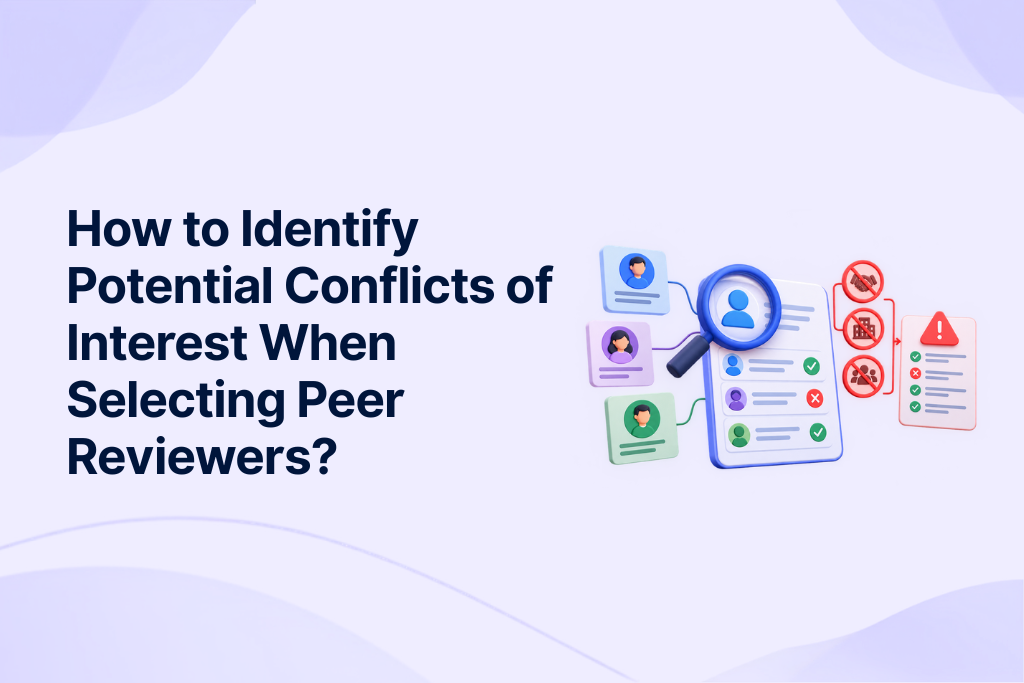
Editors can identify potential reviewer bias by checking publication histories, co-authorship, institutional affiliations, research competition, and relevant financial or personal relationships. These checks should happen before an invitation is sent, with any uncertain cases referred for editorial judgment rather than treated as automatic evidence of misconduct.
A researcher profile or publication database can reveal useful clues, but no single source provides a complete picture. The editor should connect the evidence to the manuscript and the people involved.
Check recent co-authorship and collaboration
Look for shared papers, joint grants, laboratory affiliations, and research projects involving the candidate and the manuscript’s authors. Give particular attention to recent or active collaborations.
For example, suppose a manuscript evaluates a new method for measuring soil contamination. One candidate published a paper with the corresponding author last year, while another shares the author’s institution but works in a separate department with no direct collaboration. Both relationships deserve attention, but they do not necessarily carry the same risk. The journal’s policy and specific circumstances should guide the decision.
Examine direct competition and financial interests
Search for evidence that a candidate is developing a competing technology, pursuing a patent in the same area, or receiving funding from an organization with a direct interest in the manuscript’s outcome.
Imagine a manuscript reporting that a new battery material outperforms an established alternative. A candidate who holds a patent on the competing material could have a relevant financial interest. Their technical expertise may be excellent, but the editor needs to establish whether the interest makes independent review inappropriate.
Review publication patterns and author suggestions
Check whether a candidate’s recent papers closely overlap with the submitted manuscript and whether their relationship with the authors extends beyond shared research interests. Author-suggested reviewers need the same independent checks as any other candidate.
An author recommendation is a useful lead, not proof of suitability. Verify the researcher’s identity, institutional or professional contact details, publication history, and any available evidence of collaboration. Wiley’s peer review guide for editors specifically recommends verifying the identity and expertise of author-recommended reviewers and ensuring that reviewers are independent and external.
Editors who need a broader candidate pool can also consult this guide to finding peer reviewers beyond existing networks. A wider search makes it easier to compare candidates rather than relying on the first qualified name.
What warning signs should editors check when screening reviewers?
The clearest warning signs are recent collaborations, shared institutional appointments, direct financial interests, active academic rivalries, and inconsistent identity or contact information. These are reasons to investigate, not always proof of a conflict. Editors should record what they find and decide whether the relationship prevents fair assessment.
Use the following table as a practical screening aid before assigning a reviewer.
| Warning sign | What the editor should verify | Operational Impact |
| Recent co-authorship | Shared publications and the timing of collaboration | Reduces the chance of replacing a reviewer after submission |
| Shared institutional affiliation | Current department, employment, and reporting relationships | Helps prevent avoidable conflicts at the invitation stage |
| Competing research | Overlapping projects, unpublished work, or competing claims | Protects the assessment from direct competitive interests |
| Financial connection | Relevant patents, company roles, consultancy, or funding | Helps identify interests that could affect the decision |
| Unverified identity | Institutional email, public profile, and publication record | Reduces the risk of inviting an unsuitable or misrepresented candidate |
| Author-suggested candidate | Independent verification of qualifications and relationships | Keeps reviewer selection under editorial control |
| Strong personal or academic dispute | Relevant, credible evidence of a relationship that could affect judgment | Gives editors grounds to seek another reviewer or escalate the case |
| Unclear disclosure | A candidate’s response to questions about a possible relationship | Allows the editor to resolve uncertainty before the review begins |
A warning sign should prompt a proportionate response. For instance, a candidate who shares a broad research interest with an author is not automatically conflicted. A current joint grant or a direct financial stake in the result raises a more specific concern.
The distinction matters because false positives can also harm editorial operations. Overly broad exclusions reduce the pool of qualified reviewers and can delay decisions on specialist papers. Good screening focuses on evidence and the likely effect of a relationship on impartiality.
Editors should also check whether the candidate is reviewing a manuscript that closely resembles work they are preparing for publication elsewhere. COPE identifies this situation as a potential conflict because the reviewer could have a competing interest in the timing or outcome of the research.
Managing conflicts across different peer review models
The right response depends on the relationship, the journal’s policy, and the review model. Single-blind, double-anonymous, and open peer review arrangements create different levels of visibility, but none removes the need to check reviewer independence. A consistent policy should define what editors must verify and when they should seek advice.
| Review model | Conflict-related challenge | Appropriate editorial response |
| Single-blind review | Reviewers know the authors’ identities, making professional relationships easier to recognize but leaving room for unreported interests | Check known relationships and request disclosure before the review begins |
| Double-anonymous review | Reviewers may infer authorship from citations, research topics, or distinctive methods | Ask candidates to declare suspected identities and relevant relationships where required by policy |
| Open peer review | Reviewer identities or reports may be disclosed, increasing visibility of relationships | Apply the same independence checks and maintain clear disclosure records |
| In-house editorial assessment | Editors or internal subject experts may have direct connections to the authors or research | Reassign handling responsibilities when an editor has a relevant conflict |
The same principle applies when an editor discovers a possible conflict after accepting a review. Pause the process, establish the facts, and decide whether the reviewer can continue under the journal’s policy. If the reviewer should withdraw, invite a replacement and document the reason.
A journal covering a narrow specialty may struggle to find an expert with no professional connection to the authors. In such cases, the editor should assess the nature and seriousness of the relationship, consult the journal’s peer review ethics policy, and record the reasoning behind the decision. If independence cannot be defended, another reviewer is the safer choice.
What should editors do when a potential conflict is unclear?
When the available evidence does not establish whether a relationship creates a conflict, editors should pause the assignment and seek clarification. They should avoid both automatic exclusion and automatic approval until they understand the relationship and the journal’s policy.
A practical response framework depends on what the editor discovers:
- The relationship is minor or unrelated: Record the assessment and proceed if journal policy permits.
- The relationship needs clarification: Ask the candidate a specific, neutral question before sending the manuscript or confirming the assignment.
- A material conflict is confirmed: Decline or withdraw the reviewer and identify an alternative candidate.
- The case remains disputed: Refer it to the Editor-in-Chief or the journal’s designated ethics lead.
For example, a reviewer may have co-authored a paper with one of the manuscript’s authors several years ago. If the editor cannot determine whether they still collaborate, a direct disclosure question is more useful than making assumptions based on publication dates alone.
Does disclosing a conflict mean a reviewer must be disqualified?
That should be considered on a case-to-case basis. Disclosure gives editors the information needed to assess a relationship, while disqualification removes a reviewer whose involvement would compromise, or reasonably call into question, the fairness of the assessment. The appropriate response depends on the nature of the interest and journal policy.
Editors should distinguish between a relationship that can be managed transparently and one that undermines independent judgment. A disclosed, limited professional connection may be acceptable under a journal’s rules. A direct financial stake in the outcome or a close, active collaboration may warrant a different decision.
The key questions are:
- Could the relationship affect the reviewer’s judgment?
- Would the assignment remain defensible if the relationship became known later?
- Does the journal’s policy require recusal in this situation?
Disclosure is not a substitute for independence. Equally, treating every disclosed relationship as grounds for exclusion can unnecessarily shrink the reviewer pool. A documented, policy-based decision offers a more balanced approach.
Can peer reviewer software help identify potential conflicts of interest?
Peer reviewer software can help editors find relevant candidates and organize the evidence needed for reviewer screening. Its value depends on the checks it supports. A tool that identifies researchers with relevant publications can widen the candidate pool, but subject expertise alone cannot establish that a reviewer is independent of the authors.
A useful workflow separates two questions:
1. Can this researcher assess the manuscript?
2. Is this researcher suitable to assess it independently?
The first question can be supported by publication records, research concepts, and subject matter matching. The second often requires checking affiliations, collaboration histories, disclosures, and other relationship information.
When evaluating peer reviewer software, editors should ask:
- Can the system identify candidates using the manuscript’s actual research concepts rather than broad subject keywords alone?
- Does it provide enough publication and affiliation information to support independent checks?
- Can editors review and validate the shortlist before invitations are sent?
- Can the editorial team record screening decisions and follow its own conflict-of-interest policy?
For example, a paper on machine-learning methods for early cancer detection might require expertise in computer science, medical imaging, and clinical validation. A semantic search can help editors find researchers across those fields. Editors must still check whether shortlisted candidates have recent collaborations or competing interests involving the authors.
A well-designed workflow can make it easier to find researchers outside familiar professional circles and reduce repeated manual searching. Journals can explore Reviewer Select to understand how AI-assisted reviewer discovery fits into their existing editorial process.
The important distinction is that technology supports the decision rather than making ethical judgments. Even when a system identifies an excellent candidate, the editor remains responsible for deciding whether that person can review the manuscript fairly.

Key Takeaways
- Check recent collaborations, institutional ties, financial interests, and direct research competition before inviting a reviewer.
- Treat warning signs as evidence to assess, not automatic proof of misconduct. Apply the journal’s policy and document decisions.
- Use reviewer discovery tools to broaden the candidate pool, while retaining editorial responsibility for conflict assessment and reviewer selection.
Conclusion
Journals build long-term trust through decisions that can withstand scrutiny. A clear approach to reviewer independence gives editorial teams a defensible basis for those decisions and helps them avoid costly reassignments, complaints, and questions about published research. The next step is to make conflict screening a defined part of reviewer selection, with clear responsibilities for editors and a record of how uncertain cases are resolved.
If your team is reevaluating its current peer reviewer search workflow, request a demo to see how AI-assisted reviewer discovery can streamline it.
Frequently Asked Questions
What is a reviewer conflict of interest?
A reviewer conflict of interest occurs when a personal, financial, professional, or academic interest could affect a reviewer’s impartiality. It can be actual, potential, or perceived, depending on the relationship and its circumstances.
How far back should editors check for reviewer conflicts?
COPE identifies recent relationships, including collaborations within the past three years, as relevant. Journals should follow their own policies and consider whether older collaborations, continuing projects, or financial ties remain relevant to the manuscript.
Can a reviewer assess a manuscript written by a former colleague?
Possibly. A former professional relationship does not always prevent independent assessment. Editors should consider how recent and close the relationship was, whether interests remain connected, and whether journal policy permits the assignment.
How can editors detect a reviewer conflict of interest before inviting someone?
Editors can check publication records, institutional affiliations, co-authorship, funding, patents, and competing research interests. They should also request disclosure where appropriate and document their decision when a possible conflict needs further assessment.
Does double-anonymous peer review prevent conflicts of interest?
No. Reviewers may recognize authors through citations, research methods, or distinctive findings. Double-anonymous review reduces direct identity disclosure, but editors still need to assess professional relationships, competing interests, and potential bias.
Can peer reviewer software automatically verify reviewer independence?
Peer reviewer software can support candidate discovery and provide useful research information, but it cannot guarantee independence. Editors must assess relevant relationships, request disclosures, and apply journal policies before assigning a manuscript.