


— On this page
Introduction
Managing reviewer pools across multiple journals isn’t just an operational task anymore. It’s a strategic one. Portfolio publishers often face a hidden challenge: the same reviewers get reused across imprints, leading to fatigue, slower responses, and increasing decline rates. At the same time, expanding the pool without control risks quality and ethical gaps.
The real solution isn’t choosing between consistency and freshness. It’s building a structured rotation system that keeps the pool active, diverse, and compliant. Here’s a practical playbook that editorial teams can actually implement.
1. Map Your Reviewer Utilization Before You Rotate
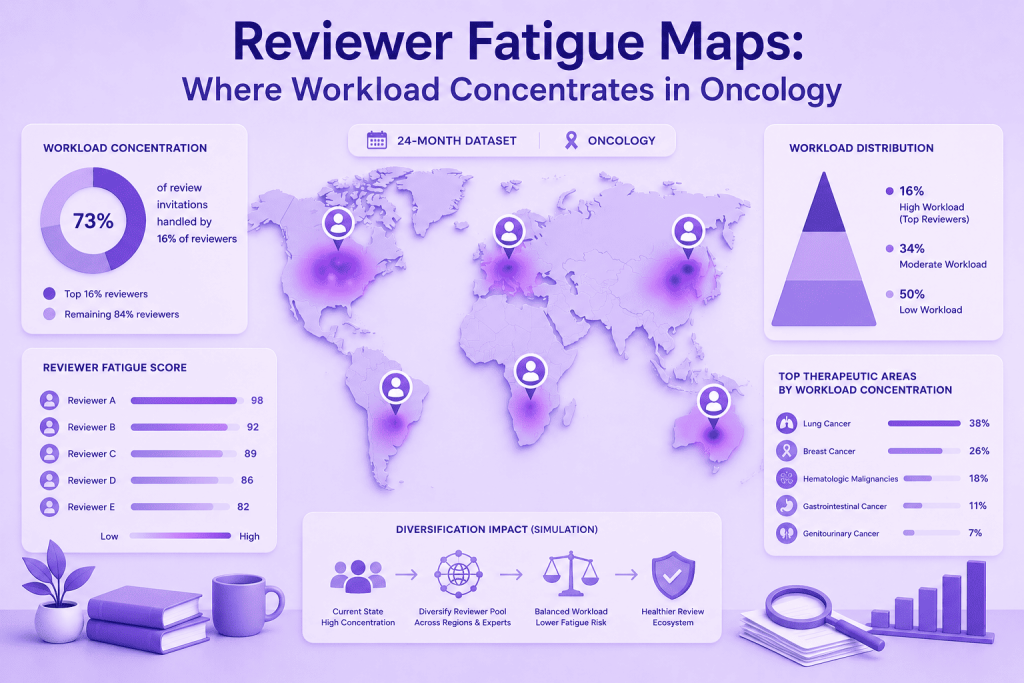
Most reviewer rotation strategies fail before they begin because publishers don’t have a system-level view of workload distribution. What looks like “editor preference” is often a structural pattern where a small subset of reviewers absorbs a disproportionate share of invitations across journals. This isn’t just inefficient — it actively reduces system capacity over time by accelerating reviewer fatigue and disengagement.
Empirical studies in peer review systems show that a minority of reviewers, often around 20%, handle up to 60–80% of total review requests, particularly in high-volume domains. Source: Nature
This concentration creates hidden risks:
- Decline rates increase as invitation frequency rises
- Turnaround times lengthen due to reviewer overload
- Editorial teams repeatedly cycle through the same fallback options
Before rotating, publishers need to quantify:
- Invitation frequency per reviewer (12–24 months)
- Acceptance vs. decline ratios
- Average response and completion time
Rotation without this baseline is just redistribution without understanding.
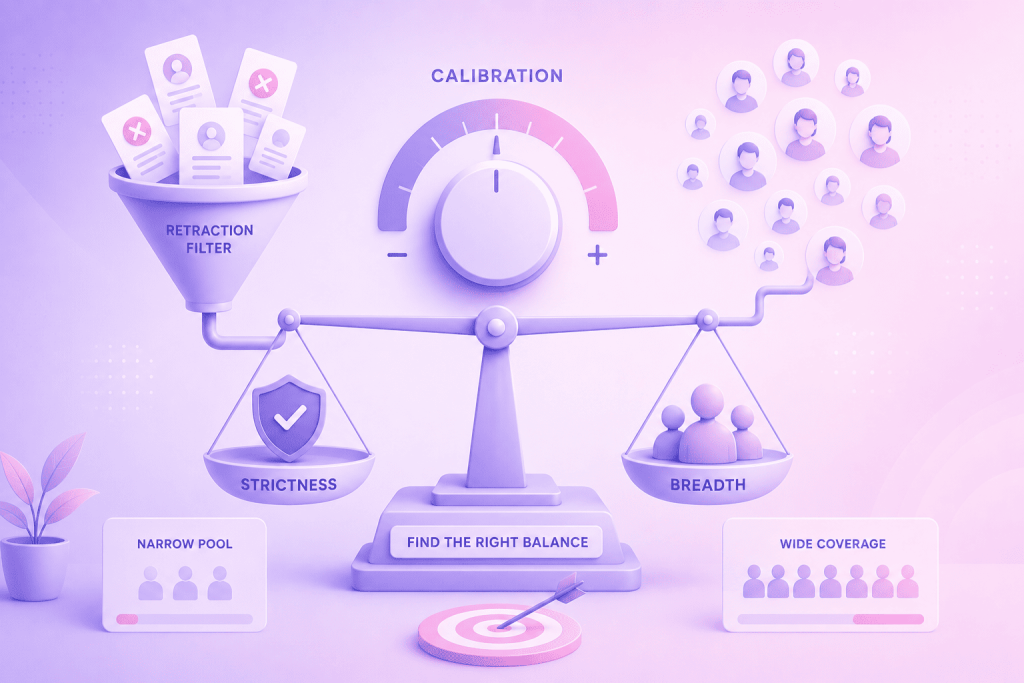
2. Set Rotation Thresholds (Don't Leave It to Editors Alone)
Reviewer fatigue is rarely caused by poor judgment. It emerges from uncoordinated decision-making across a distributed editorial system. Each editor acts locally, but the impact accumulates globally. Without shared constraints, the same high-performing reviewers are repeatedly selected across journals, often without visibility into their total workload.
Introducing thresholds converts rotation from an informal habit into a controlled system behavior.
Well-calibrated systems typically enforce:
- Maximum invitations per reviewer per defined time window
- Cooling-off periods after consecutive assignments
- Cross-imprint caps to prevent portfolio-wide overuse
3. Diversify Using Concept-Based Discovery, Not Keywords
Most publishers attempt diversification without changing their discovery logic. As a result, even when editors search for “new” reviewers, keyword-based systems return familiar names. This happens because keyword matching is inherently conservative — it prioritizes lexical overlap over conceptual alignment.
In STM fields, where terminology varies widely across subdomains, this creates a structural ceiling on discovery.
Semantic retrieval models address this by mapping manuscripts and reviewers into a shared embedding space, where similarity reflects context and meaning rather than wording. Research shows that such models can improve retrieval recall by 20–40% in complex domains like biomedical literature. Source: arXiv
4. Introduce Tiered Reviewer Pools
Reviewer pools are not uniform, but most systems treat them as if they are. This leads to two predictable outcomes: over-reliance on a small group of trusted reviewers and underutilization of the broader pool. Both reduce system efficiency.
A tiered model introduces structure by aligning reviewer usage with reliability and experience.
A typical segmentation includes:
- Core reviewers: High-trust, high-performance, used selectively
- Active reviewers: Regular contributors forming the operational base
- Exploratory pool: New, emerging, or underutilized experts
5. Track Fatigue Signals, Not Just Availability
Most systems treat reviewer availability as a binary signal — available or not. But fatigue is not binary; it builds gradually and shows up in behavioral patterns before reviewers start declining consistently.
Ignoring these signals leads to late intervention, when disengagement has already set in.
Key indicators of fatigue include:
- Increasing decline frequency over recent invitations
- Slower response times
- Reduced review completion speed