

— On this page
- What Does Research Integrity in Peer Review Actually Cover?
- What Should Editors Check Before Inviting a Reviewer?
- Identifying the Warning Signs in a Manuscript and Review
- What Should Editors Do When an Integrity Concern Emerges Late?
- Can Semantic Reviewer Search and Peer Review Software Support Research Integrity?
- How Can Journals Build a Repeatable Integrity Review Process?
- Key Takeaways
- Conclusion
- Frequently Asked Questions
A manuscript can present sound research and still raise questions about who reviewed it, whether the data are trustworthy, or whether the review process was impartial. Editors need a clear way to identify these concerns before a publication decision is made. Research integrity in peer review depends on more than checking a manuscript for plagiarism. It also requires careful reviewer selection, conflict-of-interest checks, appropriate scrutiny of research methods, and a documented response when something seems wrong.
For Editorial Directors, Journal Managers, and handling editors, the challenge is practical: how do you apply these checks consistently without creating unnecessary delays? A defined process helps editorial teams distinguish routine editorial issues from concerns that require further investigation. It also gives editors a defensible record of the decisions behind a published paper.
What Does Research Integrity in Peer Review Actually Cover?
Research integrity in peer review means protecting the reliability, fairness, and confidentiality of the process used to assess scholarly work. Editors must consider whether the research has been reported responsibly, whether reviewers are qualified and independent, and whether concerns are handled according to the journal’s policies.
In practice, integrity checks cover several connected areas:
- Research and reporting: Are the methods, data, authorship statements, ethics approvals, and disclosures appropriate for the study?
- Reviewer identity and suitability: Does the proposed reviewer have relevant expertise and a credible professional record?
- Independence: Could financial, personal, institutional, or academic relationships affect the reviewer’s judgment?
- Process integrity: Has the review remained confidential, independent, and consistent with the journal’s stated policy?
- Editorial accountability: Are concerns documented, escalated, and resolved through an appropriate procedure?
These checks apply across single-blind, double-blind, and open peer review. The review model changes what participants can see, but it does not remove the need for impartiality or credible reviewer selection.
Publication ethics also requires editors to distinguish a warning sign from proof of misconduct. An unusual result, a shared institutional affiliation, or an incomplete disclosure can justify a closer look. None automatically establishes wrongdoing.
What Should Editors Check Before Inviting a Reviewer?
Effective research integrity in peer review starts before the invitation is sent. Editors should verify the reviewer’s identity, assess their expertise against the manuscript, check for possible conflicts, and consider whether the candidate can provide an independent assessment.
A familiar name or a strong publication record is a useful starting point, but neither guarantees suitability. Reviewer screening should establish whether the person is credible, relevant to the work, and sufficiently independent to assess it fairly.
Verify identity and academic credentials
Check the reviewer’s institutional profile, publication history, and available researcher identifiers, such as ORCID. Confirm that the email address and professional affiliation are consistent with reliable records.
If a reviewer has been recommended by an author, apply the same verification standards used for other candidates. An unfamiliar email domain, inconsistent affiliations, or a publication record that does not support the claimed expertise warrants further checks. It is not, by itself, proof of identity fraud.
Match expertise to the actual manuscript
A researcher who publishes widely in a broad discipline may lack the specific expertise needed to assess a particular method or claim. An article about machine-learning-assisted diagnosis, for example, could require expertise in both clinical validation and model evaluation.
Editors need to find academic experts whose published work supports the manuscript’s central claims. Academic reviewer search based on titles, abstracts, keywords, and research concepts can help identify suitable candidates beyond an editor’s personal network.
For interdisciplinary submissions, this becomes more difficult because relevant expertise can sit across several fields. The article why peer reviewer matching is harder for interdisciplinary research explains why a broad subject label can miss important differences in research expertise.
Check conflicts of interest and independence
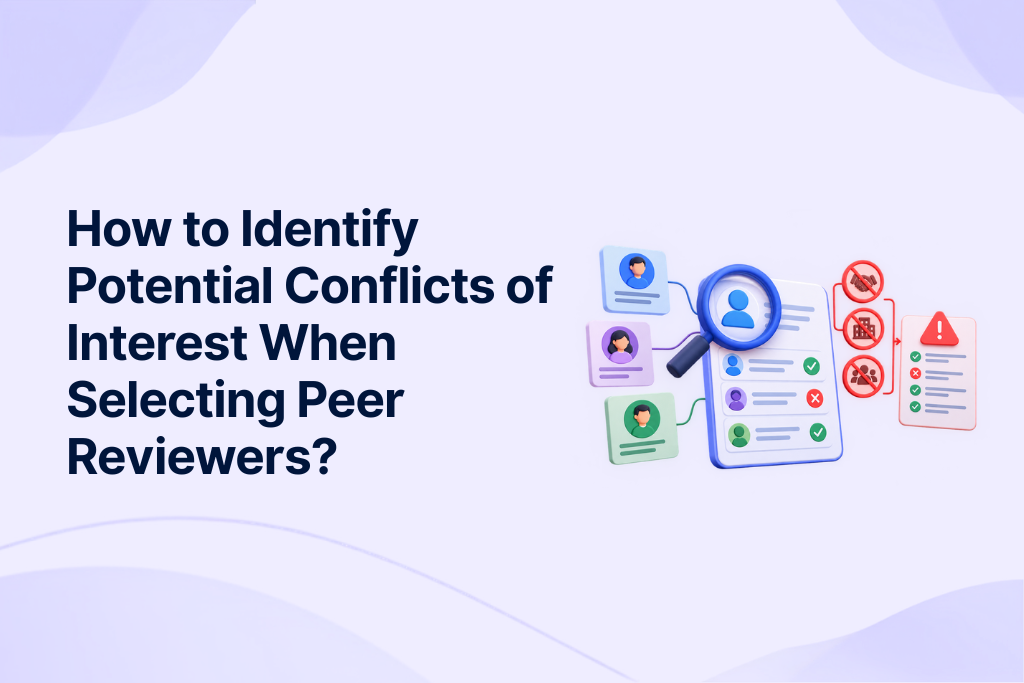
Reviewers should disclose relationships that could reasonably affect their judgment. These include recent co-authorship, shared grants, close personal relationships, direct competition, financial interests, or significant academic disputes.
A shared institution does not always mean a reviewer must be excluded. A former collaborator may pose a different risk from a current research partner. Apply the journal’s conflict policy, document the reasoning, and choose another reviewer when independence cannot be established with sufficient confidence.
Look beyond the author-suggested list
Author recommendations can be useful, particularly in narrow research fields. However, relying on them exclusively can limit independence and expose the journal to avoidable risks.
Build an independent shortlist through editorial records, relevant publications, professional networks, and verified research profiles. Good reviewer screening uses evidence from more than one source where practical. It should also account for reviewer workload and avoid repeatedly inviting the same small group of specialists.

Identifying the Warning Signs in a Manuscript and Review
Editors should examine inconsistencies in the research record, unusual reviewer activity, and irregularities in the review itself. Research integrity in peer review requires a proportionate response: establish what is known, identify what remains uncertain, and follow the journal procedures before drawing conclusions.
The following comparison offers a practical starting point.
| What to check | Possible warning sign | Appropriate editorial response | Editorial Significance |
| Data and figures | Duplicated images, unexplained alterations, or inconsistencies between figures and results | Request original data or a clarification when appropriate; consult a specialist if needed | Reduces the risk of publishing unreliable findings and costly post-publication corrections |
| Methods and ethics | Missing ethics approval, unclear consent, or methods that do not support the stated conclusions | Check discipline-specific requirements and request supporting documentation | Protects journal credibility and supports compliance with editorial policy |
| Reviewer identity | Unverifiable affiliation, inconsistent profile details, or suspicious contact information | Pause the invitation and verify identity through independent sources | Lowers the risk of compromised review and wasted editorial effort |
| Review reports | Nearly identical reports across manuscripts, irrelevant comments, or unsupported demands for citations | Examine the reports in context and seek another independent opinion if necessary | Helps preserve review quality and reduces avoidable revision rounds |
| Conflicts of interest | Undisclosed collaboration or a relationship that could affect impartiality | Request disclosure, assess the relationship, and replace the reviewer if needed | Reduces disputes over editorial fairness and decision credibility |
| Confidentiality | Evidence that unpublished material was shared or used without permission | Preserve relevant records and follow the journal’s escalation procedure | Limits damage to author trust and the journal’s reputation |
Separate a warning sign from a misconduct finding
Editors are responsible for the publication decision, but they are not always equipped to investigate research misconduct independently. If a concern involves possible data fabrication, image manipulation, or disputed authorship, follow the publisher’s procedures and consult the relevant research institution when appropriate.
COPE’s guidance on cooperation between research institutions and journals distinguishes responsibilities by assigning journals with the duty to safeguard the published record and research reliability, while institutions investigate researcher conduct, address misconduct allegations, and uphold responsible research practices.
This distinction matters. An editor who dismisses a legitimate concern risks publishing unreliable work. An editor who treats an unexplained anomaly as proven misconduct risks unfairly damaging an author’s reputation. Record the evidence, communicate carefully, and escalate according to policy.
Keep an auditable record
Document the reviewer’s identity checks, disclosures, concerns raised, author responses, and reasons for the final decision. Access should be restricted to people who need the information, especially where allegations or confidential reviewer details are involved.
A documented process also helps when a decision is challenged months later, after an editor has left the journal or a handling editor can no longer recall the details of a case.
Red Flags of a Compromised Peer Review
| Red flag | What editors should check |
| Unusually rapid review | Does the report address the manuscript’s methods, results, and limitations in sufficient detail? |
| Generic or repetitive feedback | Does the report engage with the actual research, or could the same comments apply to almost any paper? |
| Suspicious reviewer contact details | Do the email address, institutional affiliation, and researcher profile agree? |
| Unexplained citation demands | Are requested citations relevant to the manuscript, or do they appear intended to inflate particular authors’ citation counts? |
| Possible confidentiality breach | Is there evidence that unpublished findings or manuscript content were shared without permission? |
What Should Editors Do When an Integrity Concern Emerges Late?
An integrity concern discovered after peer review still requires a documented response. The editor should preserve relevant records, assess the evidence, and follow the publisher’s procedures rather than assume the completed review settled the issue.
| When the concern appears | Appropriate next step |
| Before an editorial decision | Pause the decision if necessary and seek clarification or additional assessment. |
| After acceptance but before publication | Consult the publisher’s integrity process and resolve material concerns before proceeding. |
| After publication | Refer the case to the responsible editorial or research integrity team and consider the appropriate correction, expression of concern, or retraction process if warranted. |
Keep communications factual and restrict access to those who need the information. Where allegations concern research conduct, coordinate with the relevant institution when appropriate. The response should match the evidence and follow established policy, with no presumption of guilt.
Can Semantic Reviewer Search and Peer Review Software Support Research Integrity?
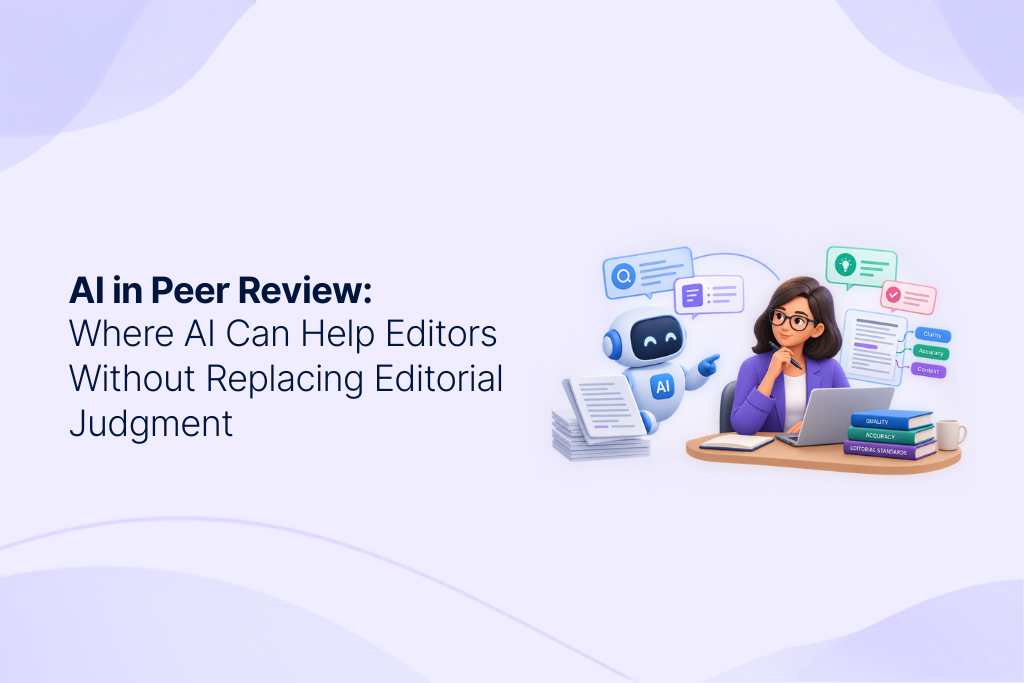
Technology can help editors apply research integrity in peer review more consistently, particularly when journals handle large submission volumes or manuscripts spanning several disciplines. However, software should support editorial judgment rather than make final ethical decisions on an editor’s behalf.
Traditional keyword searches remain useful when a manuscript has a clear, established terminology. Their limitation appears when researchers describe related concepts using different terms or when a paper crosses disciplinary boundaries.
Semantic reviewer search addresses part of this problem by comparing the meaning of research concepts rather than relying exclusively on exact keyword matches. For example, an editor assessing a manuscript about transformer-based protein structure prediction could identify relevant researchers whose publications discuss attention mechanisms or protein-folding models, even when the manuscript and article titles use different wording.
Reviewer Select’s workflow extracts concepts from a manuscript, searches relevant academic literature, and ranks potential reviewers by concept relevance, overall similarity, and concept coverage.
For editorial teams, this approach can make it easier to find academic experts outside familiar networks. It can also give editors a more transparent starting point for reviewing a shortlist.
Still, semantic matching is not a complete integrity check. A high relevance score cannot establish a person’s identity, confirm current availability, or rule out a conflict of interest. Those checks remain necessary.
Protecting Manuscripts When Using AI Tools
Editors should confirm how a tool processes manuscript text, who can access it, and whether submitted content is retained or used to train models. Confidentiality requirements apply even when a tool is introduced to improve reviewer discovery.
Before approving an AI-enabled workflow, ask the provider:
- Is manuscript content stored, and for how long?
- Can the provider or another third-party access uploaded files?
- Is manuscript data used to train or improve AI models?
- What access controls, deletion procedures, and contractual safeguards are available?
The journal should also define which tasks AI tools may support and which require direct editorial approval. Follow the publisher’s confidentiality policy and applicable data protection requirements. A useful matching result does not justify exposing confidential research to an unapproved service.
What should journals evaluate when choosing a tool?
| Evaluation criterion | Question for the editorial team | What a suitable approach should support |
| Expertise matching | Can it identify relevant work beyond exact keyword overlap? | A shortlist grounded in manuscript concepts and published research |
| Reviewer evidence | Can editors see why a person was suggested? | Traceable links to relevant publications and clear matching signals |
| Conflict checks | Does the workflow support independent disclosure and verification? | A defined process for assessing relationships and recording decisions |
| Editorial control | Can an editor challenge or refine the results? | Human review of suggestions before invitations are sent |
| Confidentiality | How are manuscript content and reviewer data handled? | Clear access controls, retention practices, and data-use policies |
| Workflow fit | Can the process work with the journal’s existing review model? | Practical adoption without bypassing editorial safeguards |
Peer review software is worth evaluating when editors repeatedly face poor matches, reviewer fatigue, inconsistent checks, or limited visibility into past decisions. A journal should assess how the tool handles confidential information and whether its outputs can be reviewed and challenged.
There is a reasonable case for retaining manual methods, especially at small journals with specialist editorial boards. Direct knowledge of a field can be valuable. The stronger approach is to retain that expertise while adding structured checks where manual processes become inconsistent or difficult to audit.
How Can Journals Build a Repeatable Integrity Review Process?
A workable policy gives editors clear responsibilities and a consistent route for handling concerns. Research integrity in peer review should be built into the journal’s normal workflow, rather than left to individual judgment whenever a difficult case appears.
A practical process can follow these steps:
- Screen the submission. Check required ethics statements, disclosures, authorship information, methods, and supporting materials against the journal’s policies.
- Verify reviewer candidates. Confirm identity, affiliation, relevant publications, and professional expertise before sending invitations.
- Assess independence. Review declared conflicts and relevant relationships. Record any decision to accept or exclude a candidate.
- Review the reports. Look for substantive engagement with the manuscript, appropriate technical comments, and signs that a report needs clarification.
- Escalate concerns. Follow the publisher policy for suspected misconduct, confidentiality breaches, or compromised reviewer identities. Involve research integrity staff or institutions when appropriate.
- Record the outcome. Preserve the rationale for editorial decisions and any actions taken, subject to the journal’s confidentiality and data-retention rules.
Assign responsibility at each stage. A journal manager might oversee completion of routine checks, while the handling editor assesses technical concerns and the Editor-in-Chief handles serious or disputed cases. Publisher research integrity specialists can advise on complex investigations.
Review the process periodically. Track how often reviewer identities need additional verification, how frequently conflicts are discovered late, and how long integrity concerns take to resolve. These measures help identify weaknesses without treating the number of flagged manuscripts as a direct measure of editorial quality.

Key Takeaways
- Research integrity depends on credible reviewer identities, relevant expertise, independence, confidentiality, and a documented response to concerns.
- Warning signs require evidence-based assessment. Editors should distinguish potential misconduct from confirmed findings and follow established escalation procedures.
- Semantic search and peer review software can support reviewer discovery, but identity verification, conflict assessment, and final editorial decisions must remain under human oversight.
Conclusion
Research integrity in peer review should be treated as an editorial governance responsibility, with clear ownership and evidence behind important decisions. Journals that review their current practices can identify where personal networks, manual checks, or disconnected records leave gaps.
The next step is to decide which weaknesses need a policy change, staff training, or better reviewer discovery support. For editorial leaders evaluating ways to improve reviewer discovery, a discussion with the Reviewer Select team can help clarify how semantic matching fits into an existing workflow. Request a demo to assess the approach against your journal’s needs.
Frequently Asked Questions
What is research integrity in peer review?
Research integrity in peer review means ensuring that manuscripts are assessed by credible, qualified, and independent reviewers through a fair and confidential process. It also includes identifying research concerns and following established procedures before publication decisions are made.
What should editors verify before inviting peer reviewers?
Editors should verify a candidate’s identity, institutional affiliation, relevant publications, subject expertise, availability, and potential conflicts of interest. Reviewer screening should use reliable evidence and apply consistent standards to author-suggested and independently identified candidates.
How should editors handle suspected research misconduct?
Editors should document the concern, request clarification where appropriate, and follow the journal’s established procedures. Serious allegations involving fabrication, falsification, or authorship disputes may require consultation with the publisher or the relevant research institution.
Can semantic reviewer search improve peer review integrity?
Semantic reviewer search can help identify researchers whose published work matches a manuscript’s underlying concepts, including across disciplinary boundaries. It supports reviewer discovery, but editors must still verify identity, evaluate conflicts, and assess suitability independently.
Does peer review software detect all research integrity problems?
No. Peer review software can support reviewer matching, workflow records, and selected screening tasks, but it cannot establish that every dataset is reliable, or every reviewer is impartial. Human assessment and appropriate investigation remain essential.
How can a journal assess whether its integrity process is working?
A journal can audit completed cases, examine how consistently the checks are recorded, monitor late-discovered conflicts, and review the time required to resolve concerns. Regular policy reviews help identify gaps without relying on a single metric as proof of quality.