

— On this page
Introduction
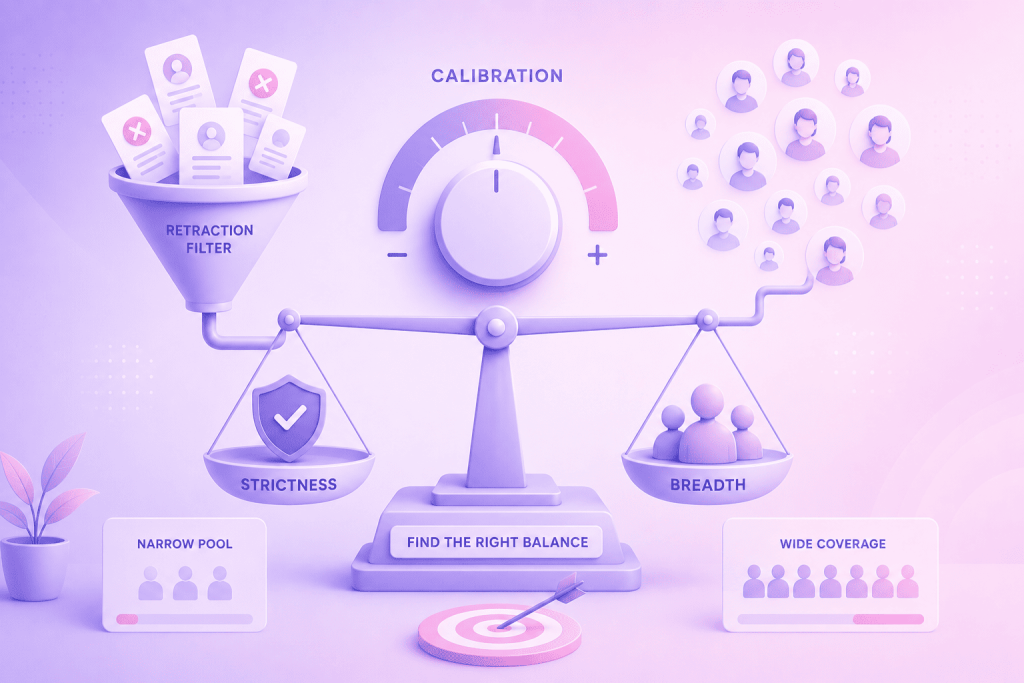
Retraction filters are meant to protect the integrity of reviewer selection. They ensure that experts with questionable publication histories or associations with retracted work don’t compromise editorial decisions. But here’s the trade-off most systems fail to manage: the stricter the filter, the narrower the reviewer pool.
The real challenge is not choosing between strictness and breadth. It’s calibrating both in a way that maintains trust without sacrificing discovery.
Why does retraction strictness impact reviewer coverage?
Retraction-based filtering works by excluding authors linked to retracted publications. On paper, this seems straightforward. In practice, it creates ripple effects.
- Not all retractions indicate misconduct. Many are due to methodological errors, publisher issues, or honest corrections
- A single retracted paper can exclude an otherwise credible expert with 10–20+ valid publications
- Strict filtering can disproportionately affect emerging fields, where experimentation leads to higher correction rates
How can editorial teams balance integrity and inclusivity?
The key lies in calibration, not elimination.
Instead of treating all retractions equally, editorial systems can apply graded strictness levels based on context:
- Nature of retraction (fraud vs. error)
- Recency of the retraction
- Author’s overall publication track record
- Co-author vs. primary author involvement
What are the three calibration profiles teams can adopt?
Editorial teams don’t need to reinvent the wheel. A structured approach with predefined profiles can simplify decision-making:
1. Strict Profile (High Integrity Mode)
Excludes all authors linked to retracted work. Best suited for high-risk or high-impact journals.
2. Moderate Profile (Balanced Mode)
Excludes authors with recent or misconduct-related retractions. Allows inclusion where retractions are older or non-critical.
3. Lenient Profile (Exploration Mode)
Flags retraction history but does not exclude reviewers automatically. Empowers editors to make final decisions.
FAQs
What is retraction strictness in reviewer selection?
It refers to how aggressively a system excludes reviewers who have been associated with retracted publications.
Are all retractions a sign of misconduct?
No. A large portion of retractions are due to honest errors, data issues, or publisher-related problems.
Final thought
The goal isn’t to remove risk entirely. That’s unrealistic. The goal is to manage risk intelligently while preserving access to the best possible reviewers.