

Introduction
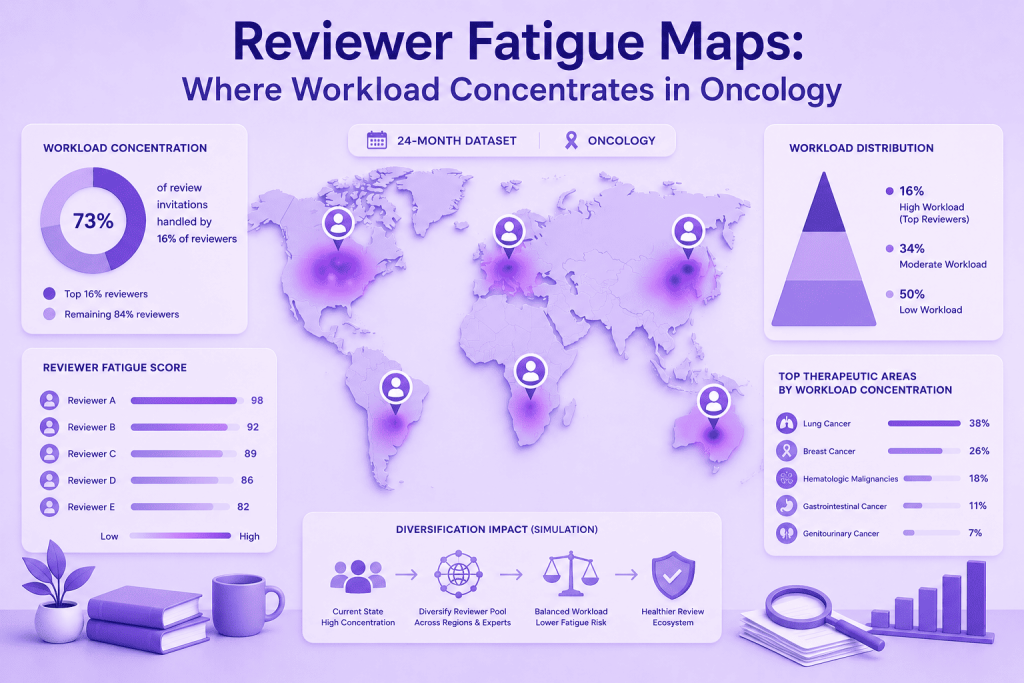
Reviewer fatigue is no longer a hidden issue in scholarly publishing. It’s measurable, predictable, and increasingly concentrated among a small subset of experts. In oncology, one of the most active and rapidly evolving research fields, this imbalance becomes even more visible.
This uneven distribution not only strains top reviewers but also impacts acceptance rates, turnaround times, and overall review quality.
Why does reviewer fatigue concentrate in oncology?
Oncology research operates at high velocity.
- Continuous clinical trials
- Rapid drug development cycles
- High publication pressure
This leads to a constant demand for expert reviewers. But instead of distributing this demand evenly, systems tend to rely on a core group of known, trusted reviewers.
FAQs
What is reviewer fatigue?
Reviewer fatigue occurs when a small group of reviewers receives too many review requests, leading to lower acceptance rates and slower responses.
How is reviewer fatigue measured?
It can be measured by tracking invitation frequency, acceptance rates, turnaround time, and workload distribution across reviewers.
Final thought
Reviewer fatigue isn’t just a people problem. It’s a system design problem. If the same experts keep getting selected, the system isn’t discovering well enough.