

— On this page
Every journal depends on a strong peer review process. Yet one task continues to frustrate editorial teams more than most: trying to find peer reviewers for manuscripts within a reasonable timeframe.
The challenge isn’t simply finding experts. It’s about finding experts who have the right subject knowledge, are free from conflicts of interest, and are willing to review within the journal’s deadlines. As research output grows and publication expectations continue to rise, this balancing act is becoming increasingly difficult.
The present article examines the five crucial reasons why it has become harder to find peer reviewers for manuscripts, why these challenges affect editorial offices across disciplines, and how platforms like Reviewer Select can improve reviewer discovery without compromising quality.
Why This Challenge Matters More Than Ever?
Editorial teams today are expected to handle more manuscript submissions, deliver faster decisions, and maintain the same high standards of originality, quality and research integrity.
Authors expect quicker turnaround times, while funding agencies and institutions increasingly value timely publication. At the same time, editors are working with research that spans multiple disciplines, making reviewer selection far more complicated.
The ripple effects are felt throughout the peer review workflow. Delays in reviewer recruitment can slow editorial decisions, extend publication timelines, and increase the workload for editorial staff.
For a journal publisher, these delays don’t just affect efficiency; they also influence author satisfaction and a journal’s reputation for handling manuscript peer review effectively.
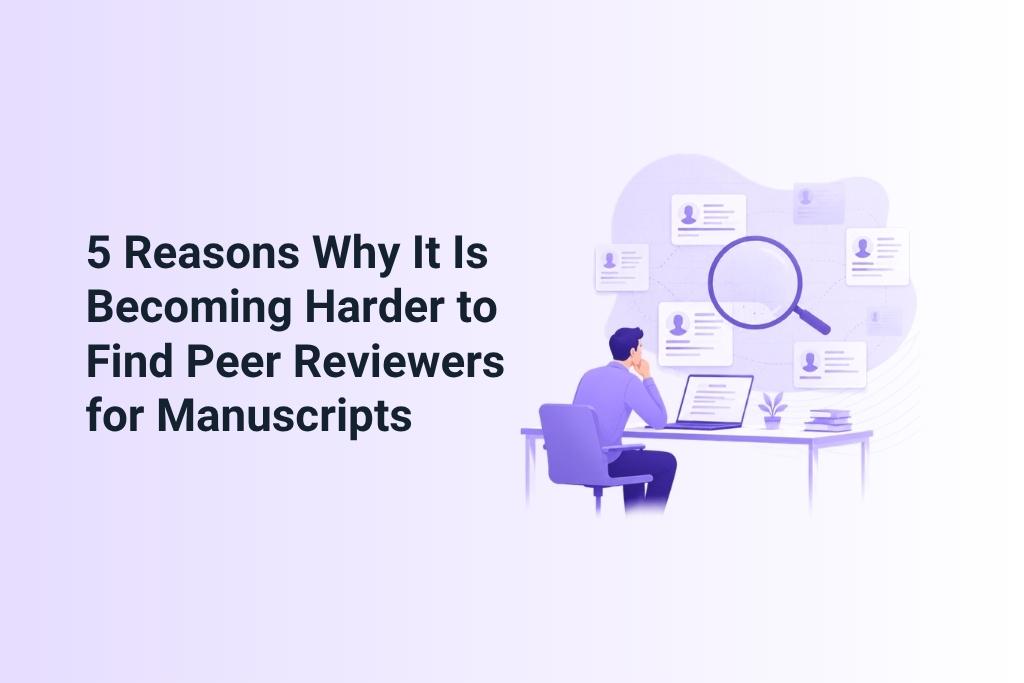
5 Reasons Why It Is Getting Harder to Find Peer Reviewers for Manuscripts
1. Too Many Manuscripts, Too Little Time, Competing Priorities
The pool of experienced reviewers hasn’t expanded at the same pace as the growth of manuscript volume. So, editors are often forced to turn to the same trusted experts repeatedly.
For many researchers, reviewing is only a part of an already demanding workload that quite often includes teaching, supervising students, writing grant proposals, and administrative duties. Declining a new review invitation is often a matter of limited time rather than lack of interest. This makes it difficult to find peer reviewers for manuscripts, more so in specialist fields having a scarcity of recognized experts.
An analysis by the National Library of Medicine of PRiMER submissions (2017–2025) found a marked decline in reviewer invitation acceptance. Acceptance rates fell from 56.14% in 2020 to 38.58% in 2025.
From editors’ perspective, many juggle editorial responsibilities alongside teaching, research, lab work, and other professional commitments, leaving less time for reviewer recruitment and manuscript management.
2. Niche,Inter disciplinary Research Topics
A manuscript might combine mining operations with environmental engineering, or materials science with avionics. Although this advances knowledge, it also makes reviewer recruitment harder.
Editors aren’t merely looking for someone familiar with a broad subject. They’re looking for an academic reviewer whose expertise closely matches the manuscript’s specific research questions, methodology, and technical depth.
Traditional databases and literature searches broadly identify researchers in similar domains, but not necessarily those with the precise expertise needed to provide a thorough evaluation. This often requires identifying multiple specialist reviewers for a single manuscript.
The challenge compounds for journals maintaining rigorous peer reviewed standards while keeping editorial timelines on track.
3. Paucity of Time for Editorial Teams
Reviewer recruitment is just one part of a much broader set of responsibilities such as initial manuscript checks, ethics screening, author communication, editorial decisions and managing publication schedule.
Rising manuscript submissions leaves editorial teams with less time to scrutinize suitable reviewers for every submission. When dozens or even hundreds of new manuscripts arrive each month, the effort required to recruit reviewers quickly becomes a bottleneck in the editorial process.
For every journal publisher, this creates a difficult balancing act. Editors need to move submissions through manuscript peer review efficiently without compromising the quality of reviewer selection.
Also, time pressure tempts editors to rely on familiar names rather than exploring a broader reviewer pool. If you are curious to learn more about how to find the right peer reviewers, we have published this detailed guide for you.
4. Reviewer Discovery Still Manual-Search Driven
Searching recent publications, reviewing reference lists, consulting editorial board members and inviting previous reviewers, all remain effective ways to identify suitable candidates.
These approaches continue to be valuable because they rely on editorial expertise, publishing ethics, and informed judgement. The caveat is that they require significant manual effort and thus can’t scale efficiently when there are fifty manuscripts coming in each week.
Visibility is another limitation. Researchers publishing in emerging areas, those early in their careers, or experts working across multiple disciplines can be difficult to discover through conventional searches. That’s why many journals struggle to find peer reviewers for manuscripts beyond their existing networks.
5. Reviewer Expectations About Reviewing Experience
Researchers have become more selective about accepting review invitations. Many now deliberate if the manuscript genuinely matches their expertise, if the review deadline is realistic, and if the journal communicates clearly throughout the process.
Receiving repeated invitations for papers that only loosely match their research interests discourages even the most committed academic reviewer. Unclear expectations and inconsistent communication reduce the likelihood of accepting future invitations.
The quality of the peer review workflow matters just as much as the invitation itself. Editorial teams that invest in better reviewer communication, realistic timelines and accurate reviewer matching often maintain healthy reviewer relationships in the long run.
Challenges, Editorial Impact, and Long-Term Consequences
| Challenge | Immediate Editorial Impact | Long-Term Business Impact |
| Reviewer fatigue | Lower invitation acceptance rates | Longer publication timelines |
| Highly specialized research | Harder to identify suitable experts | Increased editorial effort |
| Limited editorial capacity | Slower reviewer recruitment | Higher operational workload |
| Changing reviewer expectations | More invitation declines | Reduced reviewer engagement |
What Can Editorial Teams Do Differently?
Teams can expand reviewer discovery beyond the journal’s usual contacts. Early-career researchers, international experts and specialists working in adjacent disciplines can help reduce the pressure on frequently invited reviewers.
Next, make better use of publication data. Instead of relying entirely on manual searches, editorial teams can combine their own expertise with platforms that analyze research topics more holistically. This makes it easier to find reviewers whose published work closely matches the manuscript under consideration.
Modern semantic AI can analyze a manuscript’s research concepts rather than relying only on keyword matches. This allows editors to find peer reviewers for manuscripts whose expertise aligns with the context being discussed, even when different terminology is used in their publications.
AI can shorten the search process, but editors still decide who receives invitations, evaluate conflicts of interest and make the final reviewer choices. For editorial teams exploring how to find peer reviewers for manuscripts more effectively, the best approach combines editorial judgement with technology that strengthens the existing peer review workflow.
How To Choose a Reviewer Matching Platform That Supports Editors?
When evaluating a reviewer-matching platform, editorial teams should look beyond basic automation. A good solution should help editors identify relevant expertise faster while keeping the entire decision-making process transparent.
Some features of a great reviewer-matching platform include:
- Semantic matching that understands research topics, not just keywords.
- Reviewer recommendations backed by evidence.
- Built-in checks for potential conflicts of interest.
- Flexible reviewer ranking that editors can review before deciding.
- Editorial oversight throughout the reviewer selection process.
Rather than searching for keyword matches, a good reviewer-matching platform analyses a manuscript to identify its main research concepts. It then uses semantic search to compare those concepts with published research and identify experts whose work closely aligns with the manuscript.
Key Takeaways
- Interdisciplinary research and manuscript volume outpacing reviewer numbers make it hard to find the right reviewer for every manuscript.
- Manual reviewer discovery remains valuable because it depends on editorial expertise and publishing ethics.
- Improving the reviewer experience can increase invitation acceptance and strengthen the peer review workflow.
- AI can help editorial teams find peer reviewers for manuscripts more efficiently by analyzing research concepts.
- Editorial expertise remains central to effective reviewer selection.
Conclusion
Reviewer fatigue, increasingly specialized research, growing editorial workloads, manual discovery processes and changing reviewer expectations, all contribute to making reviewer recruitment more demanding.
Editorial expertise remains at the foundation of high-quality peer review, but editors no longer rely entirely on manual searching. Combining professional judgement with smarter reviewer discovery methods makes the recruitment process faster and more consistent.
For every journal publisher, the future lies in strengthening the editorial process. Whether through broader reviewer networks, improved workflows or semantic AI platforms, the goal remains the same: to find peer reviewers for manuscripts who can deliver fair, timely and high-quality reviews.
To learn more about how to connect with the right peer reviewer for your manuscripts, connect with our experts today.
Frequently Asked Questions
1. Why is it becoming harder to find peer reviewers for manuscripts?
The biggest reasons include reviewer fatigue, increasing manuscript submissions, more specialized research, limited editorial time, and changing reviewer expectations. Together, these factors make it more difficult to recruit suitable reviewers within tight publication timelines.
2. How do journal publishers usually find reviewers?
A journal publisher typically relies on editorial board recommendations, literature searches, reviewer databases, previous reviewers and author suggestions. Many journals are now supplementing these methods with AI-assisted reviewer discovery.
3. What makes a good academic reviewer?
A good academic reviewer has relevant subject expertise, understands research ethics, provides balanced and constructive feedback, and completes reviews within agreed deadlines.
4. How can journals improve their peer review workflow?
Journals can strengthen their peer review workflow by expanding reviewer pools, improving reviewer communication, using structured reviewer databases, and adopting AI tools that support reviewer discovery while keeping editors in control.
5. What is semantic reviewer matching?
Semantic reviewer matching uses AI to understand the meaning of a manuscript instead of relying solely on keywords. This helps editors identify researchers whose expertise closely matches the manuscript, making it easier to find peer reviewers for manuscripts, particularly for interdisciplinary topics.
6. How to find peer reviewers for manuscripts inspecialized research fields?
The most effective approach combines editorial expertise with broader reviewer discovery methods. Looking beyond existing networks, considering early-career researchers and using semantic AI tools can help journals find peer reviewers for manuscripts with highly specialized expertise while maintaining the quality of the review process.