

— On this page
- What is AI Reviewer Matching?
- How Does AI Reviewer Matching Move from a Manuscript to a Shortlist?
- Signals Shaping AI Reviewer Selection
- Why Can AI Reviewer Matching Fail, And How Should Editors Check It?
- How Should Editors Interpret Ranked Recommendations?
- How Should Editors Use AI Reviewer Selection Without Giving Up Control?
- Evaluating a Reviewer Recommendation System
- Key Takeaways
- Conclusion
- Frequently Asked Questions
Choosing peer reviewers is a judgment task, but finding qualified candidates is often a search task. AI reviewer matching changes that search by analyzing what a manuscript is about, connecting those concepts with researchers’ published work, and ranking candidates for editorial review. The goal is not to hand editorial decisions to a model. It is to give editors a better starting point.
For editorial leaders and handling editors, the real question is how a reviewer recommendation system moves beyond broad subject labels. A useful recommendation must connect the manuscript’s research question, methods, data, and application with evidence of a reviewer’s current expertise.
That process also needs editorial safeguards. Conflict checks, review workload, publication recency, and disciplinary coverage influence whether a suggested expert is suitable. Understanding these signals helps journals judge AI recommendations with care rather than accepting a ranked list at face value.
What is AI Reviewer Matching?
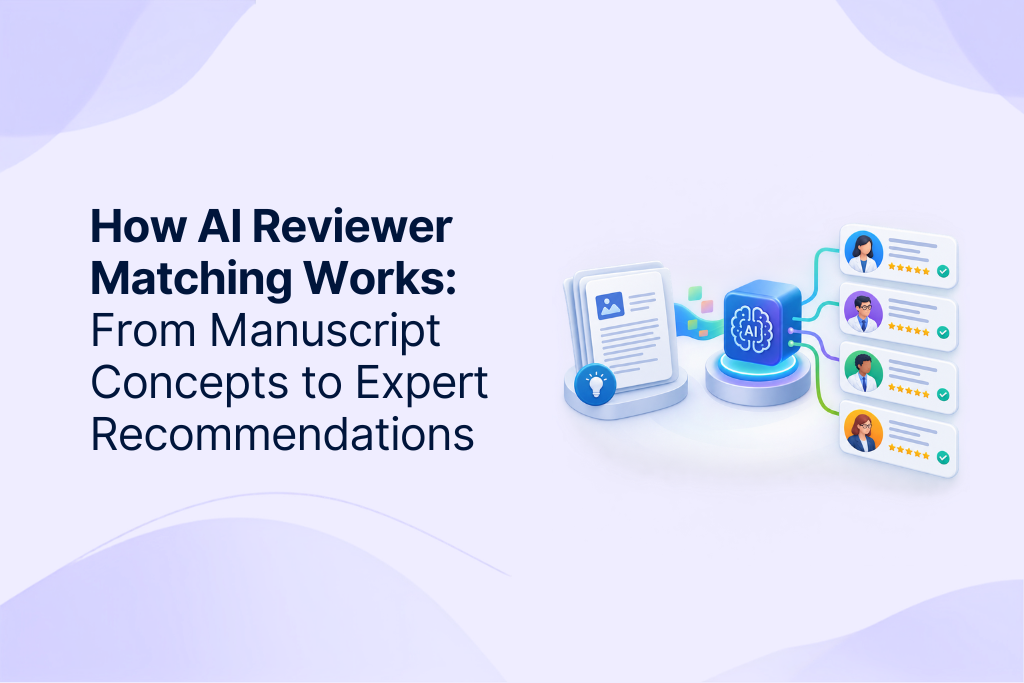
AI reviewer matching is the use of machine-learning or semantic-retrieval techniques to compare a manuscript’s research concepts with evidence from potential reviewers’ publications and profiles, producing a ranked shortlist for editorial consideration.
To identify suitable reviewers consistently, you need a system that understands the manuscript’s research concepts and compares them with evidence from potential reviewers’ work. Depending on the system, AI reviewer matching may analyze the title, abstract, keywords, full-text content, methods, datasets, and other manuscript signals. It then maps those concepts against researchers’ publications and other relevant signals.
Consider a manuscript titled “Transformer-Based Detection of Diabetic Retinopathy in Low-Resource Clinics.” A keyword search might return experts in computer vision, diabetes, or healthcare delivery separately. A semantic system looks for researchers whose work connects medical imaging, transformer models, diabetic eye disease, and clinical deployment.
This distinction matters because a reviewer can be highly cited in one part of a paper yet unsuitable for the manuscript. A statistician may understand the model but lack knowledge of ophthalmic diagnosis. A clinician may know diabetic retinopathy but not the validation method. Good matching exposes these differences early.
Why Keyword Matching Falls Short?
Keyword searches depend heavily on wording. Authors might call the same method “federated learning”, “distributed privacy-preserving training”, or “decentralized model optimization.” A database search built around one phrase can miss relevant researchers.
Semantic analysis looks at meaning, embeddings, topic classification, citation networks, and relationships between terms. It connects related concepts even when authors and reviewers use different terminology. It also helps with interdisciplinary papers, where no single keyword describes the complete contribution.

How Does AI Reviewer Matching Move from a Manuscript to a Shortlist?
To turn a manuscript into useful recommendations, you need a sequence that separates concept extraction, candidate retrieval, ranking, and editorial validation. Keeping those stages distinct helps an editor see where a recommendation came from and correct the search when the manuscript has unusual terminology.
Step 1: Extract Research Concepts
The system first processes the manuscript title, abstract, and optional keywords. It identifies the main research question and supporting details. Depending on the platform, these can include:
- Research field and subfield.
- Methods, models, instruments, or datasets.
- Population, geography, or setting.
- Disease, material, policy area, or application.
- The paper’s likely contribution.
For a public-health paper on “wastewater surveillance for antimicrobial resistance in urban hospitals,” relevant concepts could include environmental microbiology, hospital epidemiology, antimicrobial resistance, wastewater sampling, and urban health systems.
The editor should be able to inspect this interpretation. If the system treats “urban hospitals” as a central clinical topic when the paper is mainly about laboratory detection, the editor should correct the input before recommendations are generated.
Step 2: Compare Concepts with Reviewer Evidence
After extracting concepts, the system searches a reviewer pool and compares the manuscript representation with evidence from researchers’ publications. Depending on the architecture, that evidence can include semantic similarity, citation relationships, publication history, declared interests, and other bibliographic signals.
The comparison is not a simple count of shared words. It estimates how closely a reviewer’s research aligns with the manuscript’s concepts. Despite an apparent alignment, a researcher may not be the appropriate fit because of conflicts, unavailability, overburdening, shift in research areas, lack of methodological expertise, or unsuitability under journal policy.
Also, a candidate who has published repeatedly on the exact assay, population, or analytical method will generally rank above someone whose profile contains only broad field terms.
That model illustrates an important principle for AI peer review software: recommendations should remain inspectable. An editor should be able to ask, “Why this person?” and get an answer grounded in evidence.
Step 3: Apply Practical and Ethical Filters
A high relevance score is insufficient. The system should also help editors check:
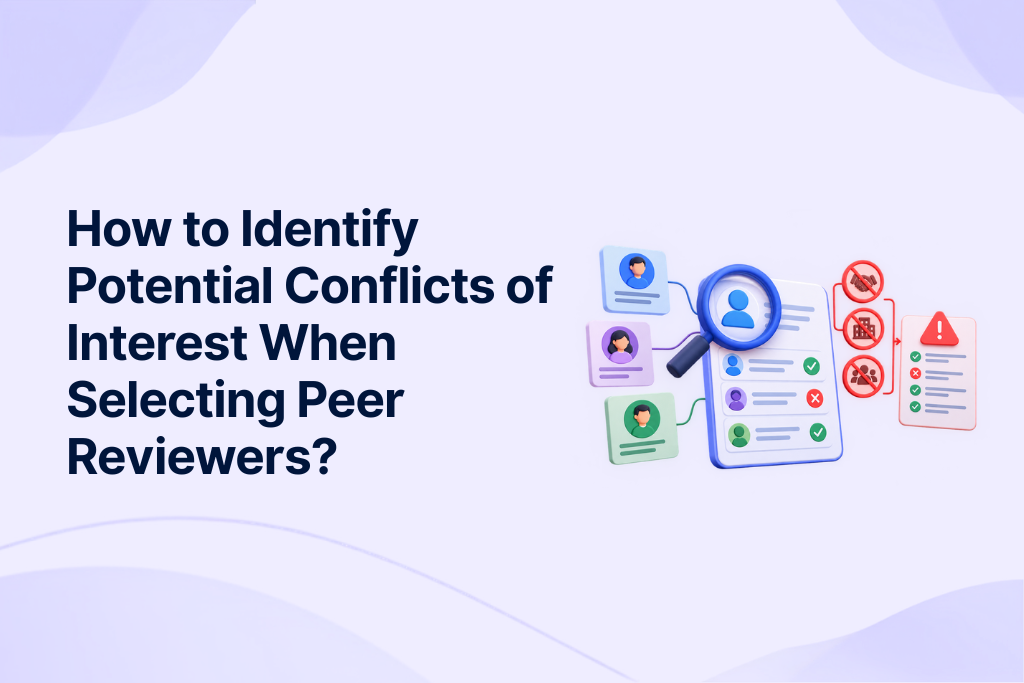
- Recent co-authorship with manuscript authors.
- Shared institutional affiliations.
- Conflicts involving funding, patents, or collaboration.
- Excessive reviewer workload.
- Recent invitations or completed reviews.
- Career stage, geography, and disciplinary diversity where relevant.
- Whether the candidate is active in the field.
The final output should explain why each person appears on the list. Evidence might include related publications, matching concepts, expertise areas, and conflict signals. Explainability gives the handling editor a defensible starting point rather than an unexplained name.
Signals Shaping AI Reviewer Selection
To select credible candidates, you need more than topical similarity. A robust AI reviewer-matching workflow may consider several complementary signals:
| Signal | What it helps assess | Editorial question | Operational Value |
| Concept similarity | Alignment between manuscript and reviewer research | Does this person understand the paper’s main contribution? | Fewer unsuitable invitations and less administrative rework |
| Publication recency | Current engagement with the topic | Is the expertise still active? | Better review relevance and lower risk of outdated assessment |
| Method fit | Experience with the study design or analytical approach | Can the reviewer evaluate the technical claims? | Stronger quality control before publication |
| Co-authorship and affiliation data | Possible conflicts of interest | Can the candidate review independently? | Lower integrity risk and better auditability |
| Workload and response history | Likely availability and responsiveness | Is an invitation realistic now? | Shorter invitation cycles and fewer repeated follow-ups |
| Diversity controls | Geographic, institutional, disciplinary, and career-stage distribution relevant to journal policy. | Does the pool avoid predictable concentration? | Wider reviewer access and a healthier editorial network |
| Editorial exclusions | Journal-specific rules and prior decisions | Does the candidate meet this journal policy? | More consistent AI reviewer selection across editors |
This is where AI reviewer matching becomes more useful than a search box. A good candidate for a paper on biodegradable polymer scaffolds might need expertise in biomaterials and tissue engineering, while a paper on the same material used for drug delivery could require a different reviewer profile.
Why Can AI Reviewer Matching Fail, And How Should Editors Check It?
To reduce reviewer-matching errors, you need human validation, conflict checks, and a way to inspect the evidence behind each recommendation. AI can rank a plausible expert who is unsuitable for other reasons, especially when the manuscript is interdisciplinary; the research area is emerging, or the underlying publication data are incomplete.
One common objection is that experienced editors already know their reviewer networks. That is true, and established networks remain valuable. They provide context that a database cannot always capture, including reviewer responsiveness, past report quality, and knowledge of a journal’s standards.
The limitation is scale. Repeatedly searching the same network can concentrate invitations among familiar experts. Reviewer fatigue can follow, and newer specialists can remain invisible to the editorial team.
A reviewer finder can widen the search, but the shortlist still needs editorial checks. Editors should verify current expertise, conflicts of interest, recent collaborations, institutional relationships, and whether the candidate has the right methodological or subject knowledge.
Did You Know?
A 2025 COLING demonstration described an automated reviewer-selection model that used NLP to match papers with experts and reported faster inference than larger transformer-based approaches. Speed is useful, but speed without appropriate safeguards is not a sufficient measure of reviewer quality. A matching model can perform expertise retrieval without addressing the broader editorial eligibility problem.
How Should Editors Interpret Ranked Recommendations?
To use a ranked list responsibly, you need to treat scores as evidence for review rather than as automatic decisions. A score can summarize similarity, but it cannot capture every reason a reviewer might accept, decline, or provide a fair assessment.
An Associate Editor handling a paper on biodegradable packaging could receive a candidate who has published extensively on polymer chemistry. The score may be high. A closer inspection might show that the candidate works only on industrial-scale manufacturing, while the paper concerns food-contact toxicity testing. The candidate is relevant, but not the best fit for the manuscript’s claims.
A practical editorial review of recommendations asks:
- Does the candidate have recent work on the paper’s central question?
- Can the candidate assess the key method, not merely the broad topic?
- Is there a clear conflict or appearance of bias?
- Has the candidate reviewed too many papers recently?
- Would the invitation expand or narrow the journal’s existing reviewer pool?
This is where AI peer review software should fit into the workflow. It can reduce search time and organize evidence. It should leave acceptance, rejection, invitation wording, and final reviewer choice with the editorial team.
How Should Editors Use AI Reviewer Selection Without Giving Up Control?
To use AI reviewer selection responsibly, you need to treat recommendations as evidence for a decision rather than as the decision itself. Editors should be able to inspect why a candidate appears, adjust the search inputs, reject unsuitable names, and apply journal-specific policies before invitations are sent.
This is especially important for interdisciplinary papers. Suppose a submission combines battery chemistry with machine-learning-based materials discovery. A candidate with dozens of battery publications may understand the scientific domain but lack experience with the computational method. Another researcher may fit the method but not chemistry. The editor can decide whether the paper needs one broad reviewer or complementary expertise.
Peer review software is most useful when it supports that reasoning. Transparent scores, linked publications, affiliation history, and conflict indicators give editors something concrete to examine.
Evaluating a Reviewer Recommendation System
To evaluate a reviewer recommendation system, you need to test both the intelligence of the match and the editorial controls around it. A system that produces impressive names but gives weak evidence can create more checking work than it removes.
7 Questions to Ask Before Choosing an AI Reviewer-Matching Platform
- What manuscript content does it analyze?
- What evidence supports each recommendation?
- Can editors see why a candidate was ranked?
- How are conflicts handled?
- How is confidential manuscript data protected?
- Can editors override or modify recommendations?
- How is recommendation quality measured over time?
The point is to judge the workflow, not the AI label. A strong matching process should make reviewer discovery faster while making the reasoning behind recommendations easier to inspect.

Key Takeaways
- AI reviewer matching interprets a manuscript’s complete research context instead of relying on isolated keywords.
- Recommendation quality depends on combining expertise evidence with independence, availability, workload, and diversity checks.
- Editorial oversight remains essential because AI can identify patterns but cannot verify every professional or personal conflict.
- Journals can assess value through measurable outcomes such as reviewer fit, invitation success, turnaround time, and reviewer-pool diversity.
Conclusion
To improve reviewer discovery without surrendering editorial judgment, you need AI reviewer matching that combines manuscript understanding, research evidence, candidate ranking, and human validation. The value lies in reducing search friction while giving editors a wider and more defensible pool of experts to consider.
The technology is best viewed as an editorial search assistant. It can find connections that keyword queries overlook, help reduce dependence on familiar reviewer networks, and bring evidence into the recommendation step. It cannot determine whether a reviewer is appropriate in every journal-specific situation.
For teams evaluating tools, our team of experts can explain in detail concept extraction, semantic matching, ranking, DOI-linked evidence, and integrity signals. Feel free to contact us for your workflow questions.
Frequently Asked Questions
1. How does an AI peer reviewer finder identify expertise?
It can analyze manuscript concepts, publication content, citations, research topics, and other bibliographic signals to identify researchers whose work aligns with the submission.
2. Is AI reviewer selection fully automated?
No. For journal workflows, AI reviewer selection is best used as decision support. Editors should validate expertise, conflicts, availability, and journal-specific suitability before inviting a reviewer.
3. Can AI reviewer matching handle interdisciplinary manuscripts?
Yes, if the system compares research meaning rather than relying only on exact keyword matches. Editors should still check whether the shortlist covers each important discipline or method in the paper.
4. Can AI detect conflicts of interest?
AI can flag likely conflicts by comparing author and reviewer affiliations, co-authorship networks, and declared relationships. It cannot know every personal, commercial, or undisclosed conflict. Editors should treat conflict detection as a warning layer. The candidate remains responsible for declaring a conflict, and the journal policy remains the final authority.
5. Why use a reviewer recommendation system instead of a keyword search?
A reviewer recommendation system can connect related concepts when authors and reviewers use different terminology. That can expand the candidate pool beyond obvious matches.
6. Can AI replace an editor’s final reviewer-selection decision?
No. AI can support candidate discovery and comparison, but editorial responsibility for reviewer suitability, conflicts, fairness, and final invitation decisions remains with the journal.